Ice Dams in Western New York
If you get an ice ridge along your eaves every February and a brown stain on the bedroom ceiling every March, you do not have a sh…
Read itHome / Roofing Advice / Roof Care
Most roofs do not fail dramatically. They wear out quietly over a couple of seasons and then leak on the coldest weekend of the year. Here is how to see it coming.
Roof Care · 6 min read · Updated July 2026
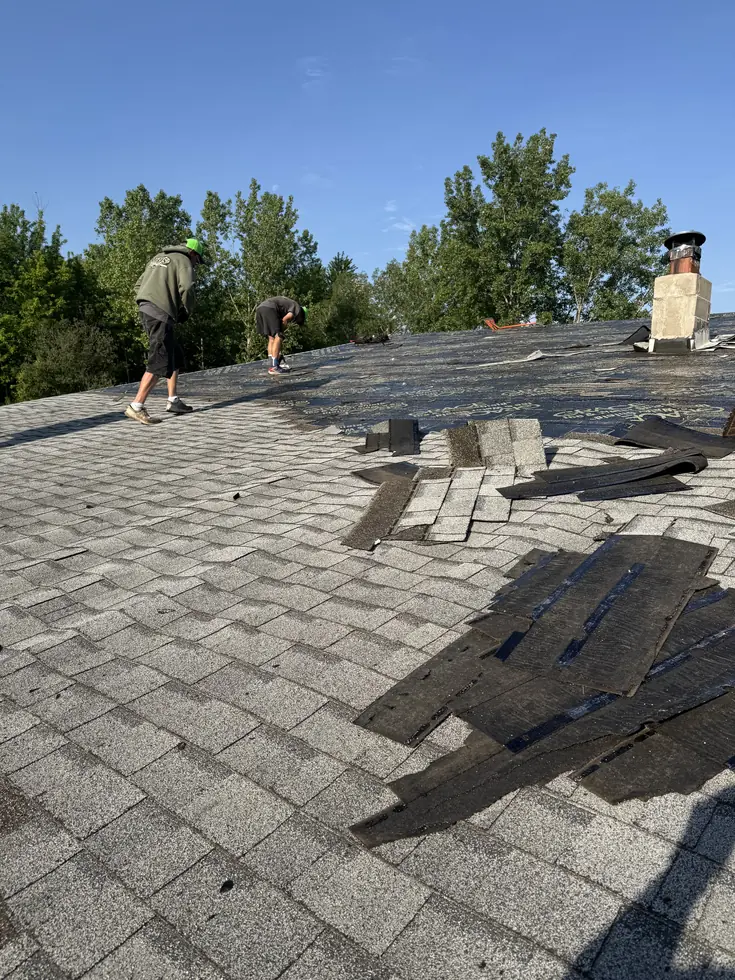
A standard asphalt shingle roof in Western New York gives you roughly 20 to 30 years. Architectural shingles sit at the upper end of that, three-tab at the lower. If you know your roof was done in the late 1990s, you are in the window regardless of how it looks from the driveway.
If you do not know the age, two shortcuts. Check whether the previous owner left paperwork, and look at your street. Subdivisions get built at the same time and re-roofed at the same time. If three neighbours have had dumpsters in the driveway in the last two summers, you are probably next.
Asphalt shingles are protected by a layer of mineral granules. When those wash off, the asphalt underneath is exposed to UV and starts to break down fast. A handful of granules after a brand-new install is normal. A steady accumulation of coarse black grit in the gutters and at the bottom of the downspouts, year after year, means the shingles are shedding their armour.
From the ground, look for slopes that appear shinier or darker in patches than the rest of the roof. That is bare asphalt showing through — usually first on the south-facing side, which takes the most sun.
Look along the roof from an angle rather than straight on. Healthy shingles lie flat. As they age they curl at the edges (cupping) or lift in the middle (clawing). Once shingles are curled they no longer seal to each other, which means wind gets underneath and driving rain gets in.
A roof that looks fine from the street and terrible from a ladder is completely normal. That is exactly why estimates should be done in person and not off satellite imagery.
WNY gets real wind. One or two shingles off after a bad storm is a repair. But if you are losing shingles every time it blows hard, the sealant strips have failed across the whole roof and the rest of them are only still up there because they have not been tested yet.
Brown rings on a bedroom ceiling, staining where a wall meets the ceiling, or bubbling paint near an exterior wall all mean water is getting in. It may be the roof, it may be flashing, it may be an ice dam, it may be a bathroom fan venting into the attic. Worth noting: the stain is rarely directly under the leak. Water travels along rafters before it drops.
This is the most useful ten minutes you can spend. On a bright day, go up with the lights off.
A visible dip or wave along the ridge or between rafters suggests the decking or the structure below it has been wet for a long time. That is not a wait-and-see item — get it looked at.
Moss and dark algae streaking are mostly cosmetic in the short term, and very common on shaded north-facing slopes in leafy neighbourhoods like Williamsville and North Buffalo. But moss holds moisture against the shingle surface, and over years that shortens the roof's life. If you are replacing anyway, algae-resistant shingles are worth the small upcharge under heavy tree cover.
The question we ask ourselves on every estimate is simple: is the problem localized or is it everywhere?
One thing we will not do is tell you that you need a full replacement when you do not. A repair customer who feels dealt with straight is how a company stays busy for thirty years on referrals.
Free estimate, in person, no obligation and no follow-up sales campaign. We have been doing this in Western New York since 1994.
The ones we get asked most often.
Roughly 20 to 30 years for asphalt shingles, with architectural shingles at the upper end. Our freeze-thaw cycle, lake-effect snow and ice damming are harder on a roof than a milder climate, so ventilation and eave protection have a big effect on where in that range you land.
Sometimes. If the rest of the roof genuinely has years left and one slope took storm damage, a partial makes sense. Be aware that shingle colors weather and get discontinued, so a partial rarely matches perfectly.
We would rather you did not. Most of what you need to know can be seen from the ground with binoculars, from the gutter, and from inside the attic. Roofs are the leading cause of serious falls around the home, and a free estimate costs you nothing.
Most Western New York homes are a one to two day job once we start. Larger or more complicated roofs run longer, and we tell you which yours is before we begin.
If you get an ice ridge along your eaves every February and a brown stain on the bedroom ceiling every March, you do not have a sh…
Read itAfter a bad WNY windstorm two things arrive: water in the house, and a knock on the door from somebody with an out-of-state plate.…
Read it