7 Signs Your Roof Needs Replacing
Most roofs do not fail dramatically. They wear out quietly over a couple of seasons and then leak on the coldest weekend of the ye…
Read itHome / Roofing Advice / Roof Care
If you get an ice ridge along your eaves every February and a brown stain on the bedroom ceiling every March, you do not have a shingle problem. You have an attic problem.
Roof Care · 7 min read · Updated July 2026
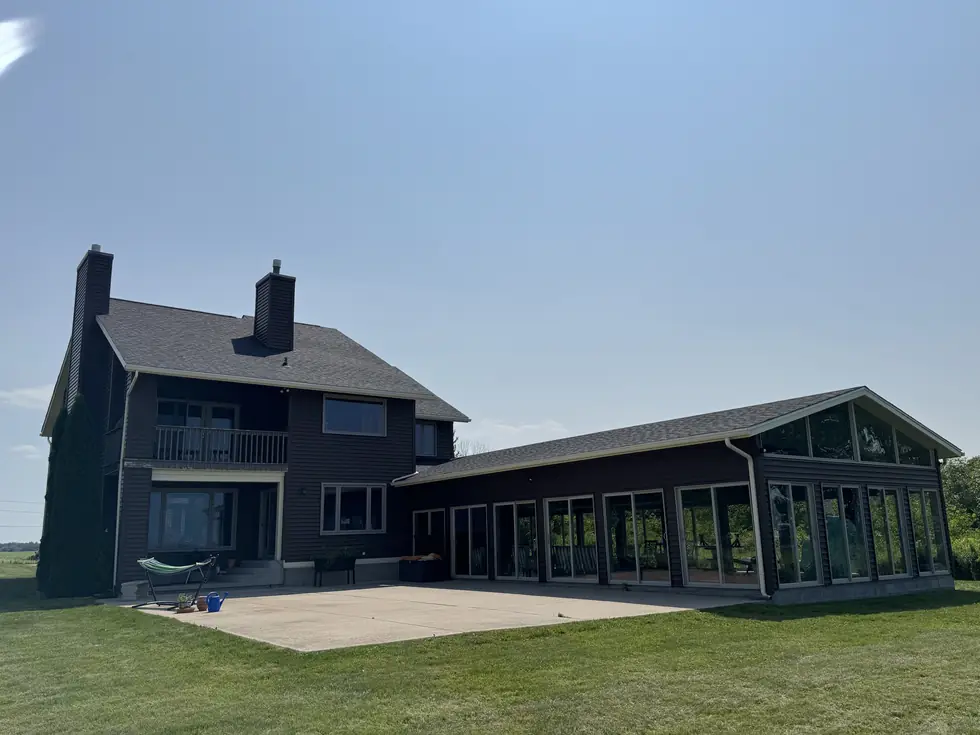
An ice dam is a ridge of ice that builds along the cold edge of your roof and traps meltwater behind it. The water has nowhere to drain, so it sits, finds the seams between shingles, and works its way backwards under them and into the house.
Here is the sequence. Snow sits on your roof. Heat leaking out of your living space warms the underside of the roof deck. Snow on that warmed upper section melts, even when it is well below freezing outside. That meltwater runs down the roof until it reaches the eave — the overhang, which hangs out past the heated part of the house and stays at outdoor temperature. There it refreezes. Repeat that for a week of a typical Buffalo cold snap and you have a dam several inches thick, with a pool of standing water sitting behind it.
The shingles are not failing. Asphalt shingles are designed to shed water running downhill. They are not designed to hold back a pond. No shingle on the market will keep water out under an ice dam.
Two things stack against us. The first is lake-effect snow — we get deep, persistent snow cover that sits on the roof for weeks instead of falling off. The second is our freeze-thaw pattern. WNY spends a lot of the winter oscillating right around freezing, which is precisely the condition that melts and refreezes water repeatedly. A place that stays at ten below all winter actually has fewer ice dam problems than we do, because nothing melts.
Add in the age of a lot of our housing stock. Pre-war homes in Buffalo, Lockport and the Village of Williamsville were built with little or no attic ventilation and, by modern standards, almost no insulation. Those houses leak heat straight into the attic. That is the fuel for the whole process.
This is the one almost everybody skips, and it is the most important. Warm air escapes into your attic through gaps you cannot see: around recessed lights, at the top plates of interior walls, around plumbing stacks and bath fans, through the attic hatch, down open chases. Sealing those bypasses stops the heat getting up there in the first place. Insulation alone does not do this — insulation slows heat conduction, it does not stop air leakage.
Once the air leaks are sealed, insulation keeps the attic close to outdoor temperature. Current recommendations for our climate zone put attic insulation in the R-49 to R-60 range. A lot of the WNY homes we work on are sitting at R-19 or less, often compressed or with bare patches where somebody stored boxes.
Cold air needs to move through the attic to carry away any heat that does get up there. That means intake at the soffits and exhaust at the ridge, roughly balanced. A ridge vent with blocked or painted-over soffit vents does almost nothing — there is no intake, so there is no airflow. When we replace a roof we check the soffit intake, because installing a beautiful ridge vent over a sealed soffit is theatre.
Ice-and-water shield is a self-adhering waterproof membrane that goes down on the bare deck before the underlayment and shingles. It seals around nail penetrations, so even when water backs up behind a dam, it cannot get into the structure.
New York's residential code requires an ice barrier in areas subject to ice damming, running from the eave edge to at least 24 inches inside the exterior wall line. That is a minimum, not a target. On low-slope sections, in valleys, and on north-facing slopes with heavy shade, we routinely go further than code, because we have seen where the water actually gets in.
Ice-and-water shield does not prevent ice dams. It prevents the ice dam from wrecking your ceiling. Both matter, but they are different jobs.
Zig-zag heat cables along the eaves melt a channel through the dam so water can drain. They are a symptom-management tool, not a fix. They cost money to run all winter, they fail, and they do nothing about the heat loss that is causing the problem. Occasionally they are the right call — on a complicated roofline where the real fix is not practical — but they should be a last resort, not a first one.
Pulling snow off the lower three or four feet of the roof does genuinely help in the short term, because it removes the material that forms the dam. Two cautions: do it from the ground with a proper roof rake, never from a ladder in winter, and do not scrape the shingle surface. Dragging a metal edge across cold asphalt shingles knocks granules off and shortens the roof's life.
Please do not. Every winter somebody goes up with a hatchet or a hammer and puts a hole through their own roof. Cold shingles are brittle. If you have active water coming in and need it stopped now, call us.
Go up in the attic on a cold day, and take a flashlight.
If you find any of that, the fix starts inside the house, not on the roof. If your roof is also near the end of its life, doing the attic work and the roof at the same time is the sensible order of operations — we can get at the eave detailing and ventilation while the shingles are off.
Free estimate, in person, no obligation and no follow-up sales campaign. We have been doing this in Western New York since 1994.
The ones we get asked most often.
Not by itself. A new roof with proper ice-and-water shield will stop the ice dam from damaging your ceilings and walls, which is a real and significant benefit. But the dam will still form unless you also address the heat loss and ventilation that cause it. We will tell you that up front rather than sell you a roof and let you find out in February.
It depends entirely on how long it went on. Caught early, it may be a ceiling patch and paint. Left for a few seasons it can mean soaked insulation, mold, rotted sheathing and damaged framing at the eave, which is a much larger job. The cheap version is the one you catch early.
Often, yes — many policies cover the resulting water damage, though not the cost of preventing it. Coverage varies by policy and insurer, so check yours. We can document the damage for a claim.
New York's residential code requires an ice barrier in areas prone to ice damming, extending from the eave to at least 24 inches inside the exterior wall line. Western New York is squarely in that category. Any quote you get should include it — if it does not, ask why.
Most roofs do not fail dramatically. They wear out quietly over a couple of seasons and then leak on the coldest weekend of the ye…
Read itAfter a bad WNY windstorm two things arrive: water in the house, and a knock on the door from somebody with an out-of-state plate.…
Read it